
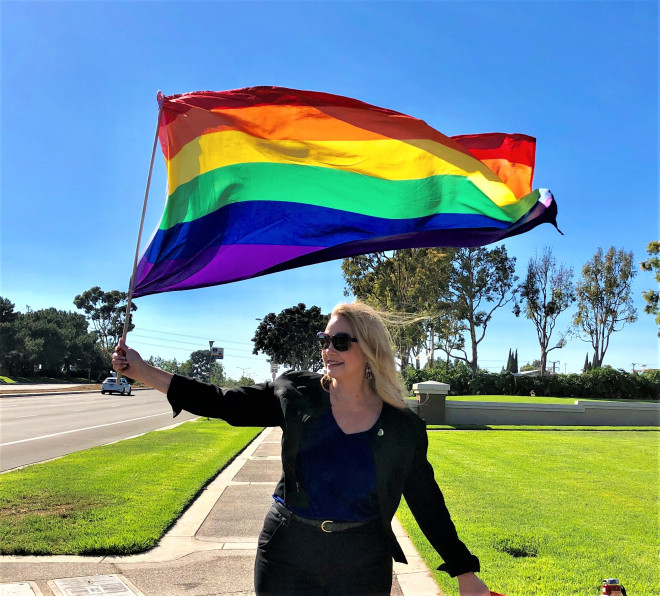
At the Tues., July 14, 2020, Irvine City Council meeting, I will move to repeal Irvine’s anti-LGBTQ ordinance [Sec. 3-5-501 through 503] as unconstitutional under the Equal Protection Clause of the United States Constitution and in violation of California’s Unruh Civil Rights Act, which explicitly prohibits discrimination against people based on “sexual orientation.”
Councilmember Farrah Khan has agreed to join me in putting this item on the July 14 Council agenda and in supporting this motion.
Most residents of Irvine do not know that our diverse and forward-thinking city has an ordinance on the books that specifically and explicitly denies anti-discrimination protection to people based on their sexual orientation.
In fact, most residents are shocked when they learn that the Irvine Municipal Code includes the following:
“Sec. 3-5-503. – City Council parameters.
Except as provided in section 3-5-502, the City Council shall not enact any City policy, law or ordinance that:
A. Defines sexual orientation as a fundamental human right.
B. Uses sexual orientation, in whole or in part, as the basis for determining an unlawful discriminatory practice and/or establishes a penalty or civil remedy for such practice.
C. Provides preferential treatment or affirmative action for any person on the basis of their sexual orientation.”
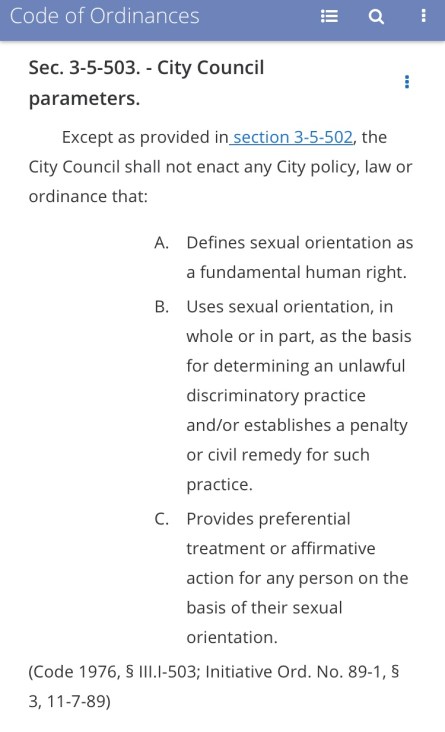 These provisions were added by Ord. No. 89-1, which was adopted as Measure N by 53% of the voters as an initiative on Nov. 7, 1989, overturning an Irvine Human Rights Ordinance enacted by the Council in July 1988 that prohibited discrimination based on sexual orientation.
The main proponent of the Measure N ballot initiative and the subsequent anti-LGBTQ ordinance was a group calling itself the “Irvine Values Coalition,” led by carwash-developer Michael Shea and his then-wife (and later Irvine mayor) Christina Shea.
According to Christina Shea, the initiative was needed because the earlier Human Rights ordinance gave “special legislative protection to the homosexual, bisexual and lesbian communities” and “homosexuality is characterized by a wide range of sexual perversions, varying degrees of promiscuity and a disproportionate percentage of sexually transmitted diseases.”
This anti-LGBTQ ordinance violates both the Equal Protection Clause of the United States Constitution and California’s Unruh Civil Rights Act.
In Romer v. Evans, 517 U.S. 620 (1996), the U.S. Supreme Court ruled that the Equal Protection Clause of the Constitution prohibits a state from banning LGBTQ people from seeking “specific legal protection from injuries caused by discrimination.”
The facts of Romer v. Evans are as follows: after various cities and counties in Colorado enacted laws prohibiting discrimination based on sexual orientation, the State of Colorado, through a ballot initiative, amended its state constitution to “prohibit[] all legislative, executive or judicial action at any level of state or local government designed to protect . . . homosexual persons or gays and lesbians.” As the Supreme Court explained, under the amendment, “Homosexuals, by state decree, are put in a solitary class with respect to transactions and relations in both the private and governmental spheres. The amendment withdraws from homosexuals, but no others, specific legal protection from the injuries caused by discrimination, and it forbids reinstatement of these laws and policies.”
The Supreme Court declared that the Colorado constitutional amendment was based upon animosity toward homosexual people and lacked a rational relation to any legitimate governmental purpose. Accordingly, the Court determined that Colorado’s constitutional amendment violated the Equal Protection Clause of the 5th Amendment of the U.S. Constitution, applicable to the states through the 14th Amendment.
Like the Colorado constitutional amendment that the Supreme Court invalidated in Romer v. Evans, Irvine’s anti-LGBTQ ordinance attempts to prohibit local government action “designed to protect . . . homosexual persons or gays and lesbians” [i.e., protects people based on “sexual orientation.”] and like the Colorado constitutional amendment invalidated in Romer v. Evans, Irvine’s anti-LGBTQ ordinance “withdraws from homosexuals, but no others, specific legal protection from the injuries caused by discrimination.”
 Accordingly, Romer v. Evans renders Irvine’s anti-LGBTQ ordinance unconstitutional.
Moreover, not only is Irvine’s anti-LGBTQ ordinance unconstitutional, it also clearly contradicts and is superseded by California’s Unruh Civil Rights Act, which explicitly prohibits discrimination against people based on “sexual orientation.”
Because state law supersedes any city law or local ordinance, the Unruh Civil Rights Act’s prohibition of discrimination on the basis of sexual orientation anywhere in California means that Irvine lacks the power to declare that “the City Council shall not enact any City policy, law or ordinance that: Uses sexual orientation, in whole or in part, as the basis for determining an unlawful discriminatory practice and/or establishes a penalty or civil remedy for such practice.”
Irvine anti-LBGTQ initiative was one of several ballot measures across the nation in the late 1980s and early 1990s not only to seek to repeal existing anti-discrimination ordinances, but to proactively prohibit any local unit of government from ever passing such ordinances in the future.
Hence, the Irvine anti-LGBTQ ordinance includes provisions that purport to make it extremely difficult for a future Irvine City Council to repeal it. According to the ordinance, “Any law or ordinance pertaining to Section 3-5-503 may only be enacted by obtaining the approval of a majority of the voters of the City of Irvine voting on the measure at a regular or special election. Such a measure may only be placed on the ballot by citizen’s initiative or a two-thirds majority vote by the City Council.” [Sec. 3-5-502.].
The Supreme Court in Romer v. Evans made clear that it is an unconstitutional violation of the Equal Protection Clause to single out LGBTQ people for special burdens. including burdening them with special difficulties in enacting anti-discriminatory laws. According, it is clear that the procedural provisions of Irvine’s anti-LGBTQ ordinance — requiring a 2/3 vote of the Council and then a ballot initiative for repeal — is again a violation of the Equal Protection Clause of the 5th and 14th Amendments because it is designed to make passage of protections against discrimination based on sexual orientation especially burdensome and difficult.
The California Legislature dealt with this very issue in its repeal of the unconstitutional sections of Prop 187 by Senate Bill 396 (2014) by a majority vote of the Legislature without a vote of the entire electorate.
As the Judicial Committee of the California Senate noted, “Under existing law, California’s Constitution only authorizes the Legislature to amend or repeal initiative statutes by way of another statute that becomes effective only when approved by the electors –unless the initiative statute permits amendment or repeal without their approval. (Cal. Const., art. II, Sec. 10, subd. (c).) This bill [SB 396] seeks to repeal several state statutes implemented upon voter approval of Proposition 187, which generally prohibited the provision of various benefits to undocumented aliens. That proposition did not authorize the Legislature to amend or repeal its provisions without voter approval.”
Nevertheless, the Judicial Committee found that the Legislature had authority to repeal the unconstitutional sections of Prop 187 without a vote of the entire electorate. It reasoned that because the bill did not modify or repeal any provisions of Prop 187 except those that are unconstitutional and therefore unenforceable, it did not make any change in existing law. Accordingly, “SB 396 would not impermissibly repeal or amend the initiative; rather, it would merely update California statutes to accurately reflect current law.” The bill passed the Assembly and the Senate with only a single No vote.
The same circumstances exist here.
Like the parts of Prop 187 repealed by a simple majority vote of the Legislature in 2014, the anti-LGBTQ ordinance is unconstitutional and enforceable. Like the unconstitutional parts of Prop 187, although Irvine’s anti-LGBTQ ordinance is unconstitutional and unenforceable, its language remains on the books. Keeping this discriminatory language on the books, “causes confusion and harmful outcomes . . . [Therefore], it is fitting that [we] expressly acknowledge the detrimental impact of the discriminatory [language] by removing its stain from the state’s statutes.”
That is what our City Council needs to do now, and what the precedent of SB 396 gives us clear authority to do: “expressly acknowledge the detrimental impact of the discriminatory [language of Sec. 3-5.501-503] by removing its stain from the [City’s Code.]”
In addition to being unconstitutional and in violation of superseding state laws, Irvine’s anti-LGBTQ ordinance is a cruel and embarrassing relic of a more prejudiced time.
Does Irvine want to remain on record as being one of the very few cities in America, and indeed the world, that still officially discriminates against people based on their sexual orientation? I hope not.
For all of these reasons, I will move to repeal Irvine’s anti-LGBTQ ordinance.
As noted above, Councilmember Farrah Khan has agreed to join me in putting this item on the next Council agenda for Tues., July 14, 2020, and in supporting this motion.
If you agree with us, please tell Mayor Christina Shea and the rest of the Irvine City Council that Irvine’s anti-LGBTQ ordinance [Sec. 3-5-501 through 503] needs to be repealed NOW.
Contact the Mayor and the Irvine City Council by email here.
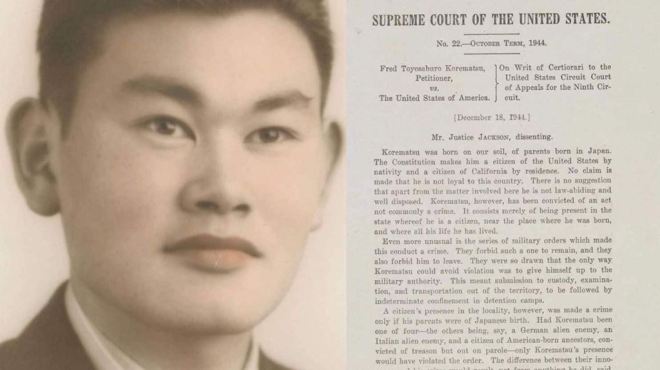
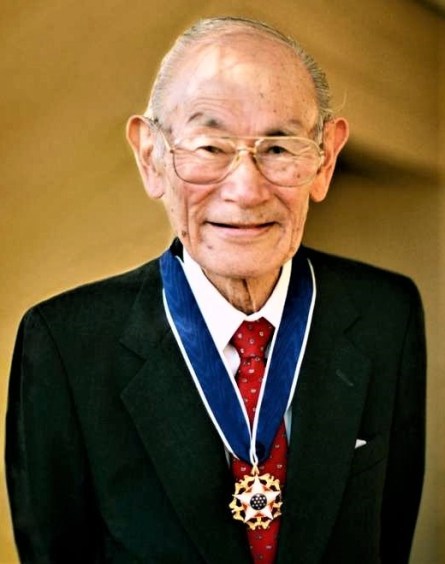 Although Koresatsu lost his case in 1944, his fight against racism and for justice has been vindicated by history.
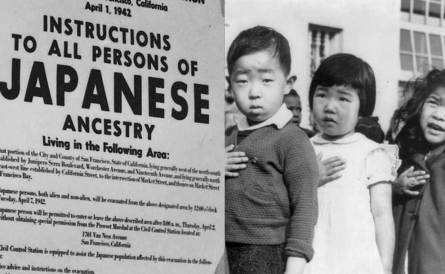
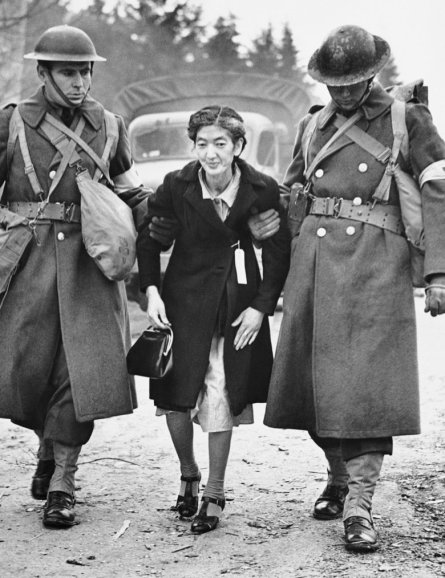 On May 3, 1942, when General DeWitt ordered Japanese Americans to report on May 9 to Assembly Centers as a prelude to being removed to the internment camps, Korematsu refused and went into hiding in the Oakland area. He was arrested on a street corner in San Leandro on May 30, 1942. Shortly after Korematsu’s arrest, Ernest Besig, the director of the American Civil Liberties Union in northern California, asked him whether he would be willing to use his case to test the legality of the Japanese American internment. Korematsu agreed.
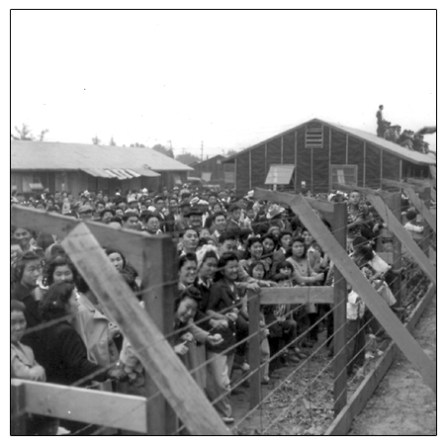
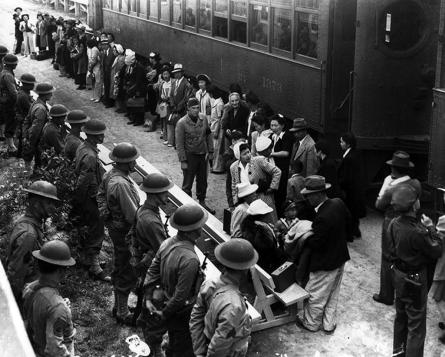 He was taken from the courtroom and returned to the Tanforan Assembly Center, and thereafter he and his family were placed in the Central Utah War Relocation Center in Topaz, Utah. As an unskilled laborer, he was eligible to receive only $12 per month (equivalent to $184.01 in 2018) for working eight-hour days at the camp. He was placed in a horse stall with a single light bulb, and later said “jail was better than this.”
 Dissenting Justice Frank Murphy criticized what he called a “legalization of racism.” Justice Murphy added: “Racial discrimination in any form and in any degree has no justifiable part whatever in our democratic way of life. It is unattractive in any setting, but it is utterly revolting among a free people who have embraced the principles set forth in the Constitution of the United States. All residents of this nation are kin in some way by blood or culture to a foreign land. Yet they are primarily and necessarily a part of the new and distinct civilization of the United States. They must, accordingly, be treated at all times as the heirs of the American experiment, and as entitled to all the rights and freedoms guaranteed by the Constitution.”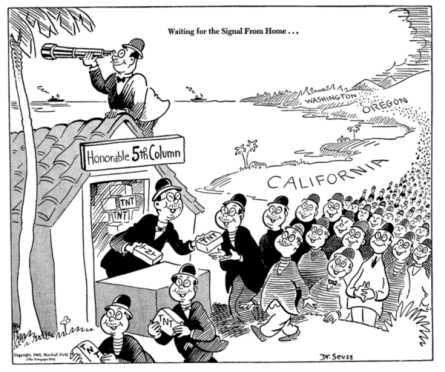
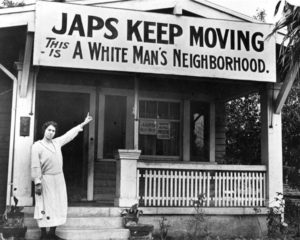 After being released from the camp in Utah, Korematsu had to move east since the law would not allow former internees to move back westward. He moved to Salt Lake City, Utah, where he continued to fight racism. He still knew there were inequalities among the Japanese, since he experienced them in his everyday life. He found work repairing water tanks in Salt Lake City, but after three months on the job, he discovered he was being paid half of what his white coworkers were being paid. He told his boss that this was unfair and asked to be paid the same amount, but his boss only threatened to call the police and try to get him arrested just for being Japanese, so he left his job.
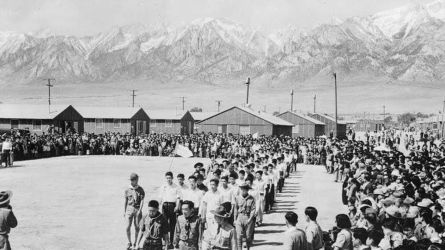 On November 10, 1983, Judge Marilyn Hall Patel of U.S. District Court in San Francisco formally vacated the conviction. Korematsu testified before Judge Patel, “I would like to see the government admit that they were wrong and do something about it so this will never happen again to any American citizen of any race, creed, or color.” He also said, “If anyone should do any pardoning, I should be the one pardoning the government for what they did to the Japanese-American people.” Judge Patel’s ruling cleared Korematsu’s name, but was incapable of overturning the Supreme Court’s decision.
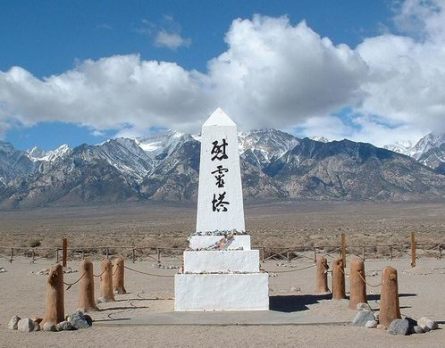
 From 2001 until his death in 2005, Korematsu served on the Constitution Project’s bipartisan Liberty and Security Committee. Discussing racial profiling in 2004, he warned, “No one should ever be locked away simply because they share the same race, ethnicity, or religion as a spy or terrorist. If that principle was not learned from the internment of Japanese Americans, then these are very dangerous times for our democracy.”
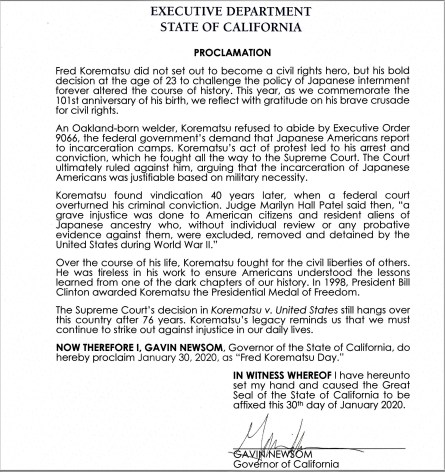
 The proclamation by Governor Newsom reads as follows:
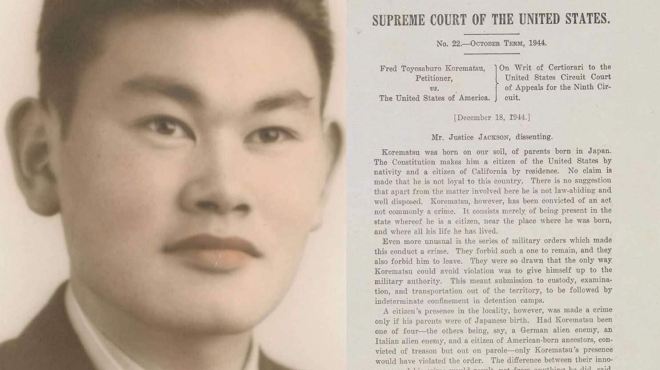 “If you have the feeling that something is wrong, don’t be afraid to speak up.” — Fred T. Korematsu (1919-2005)
 Fred Toyosaburo Korematsu was born in Oakland, California, on January 30, 1919, the third of four sons to Japanese-American parents Kakusaburo Korematsu and Kotsui Aoki, who immigrated to the United States in 1905. He attended public schools, participated in the Castlemont High School (Oakland, California) tennis and swim teams, and worked in his family’s flower nursery in nearby San Leandro, California.
 Korematsu spoke out after September 11, 2001, on how the United States government should not let the same thing happen to people of Middle-Eastern descent as what happened to Japanese Americans. When prisoners were detained at Guantanamo Bay for too long a period, in Korematsu’s opinion, he filed two amicus curiae briefs with the Supreme Court and warned them not to repeat the mistakes of the Japanese internment.
 Melissa Fox, Esq.
You must be logged in to post a comment.